
A New and Effective Method in Cancer Surgery
Doctors
 Artem V. Stepanyan
Medicine is developing rapidly, and oncology is also seeing many new advances. One of them is a new method recently introduced and successfully used at Nairi Medical Center for the surgical treatment of certain gynecological cancers.
This method makes it possible to identify and remove only the affected lymph nodes during laparoscopic surgery with the help of special imaging equipment.
This approach is an important step forward for patients with cancer, as it can help reduce the risk of complications and improve quality of life after treatment.
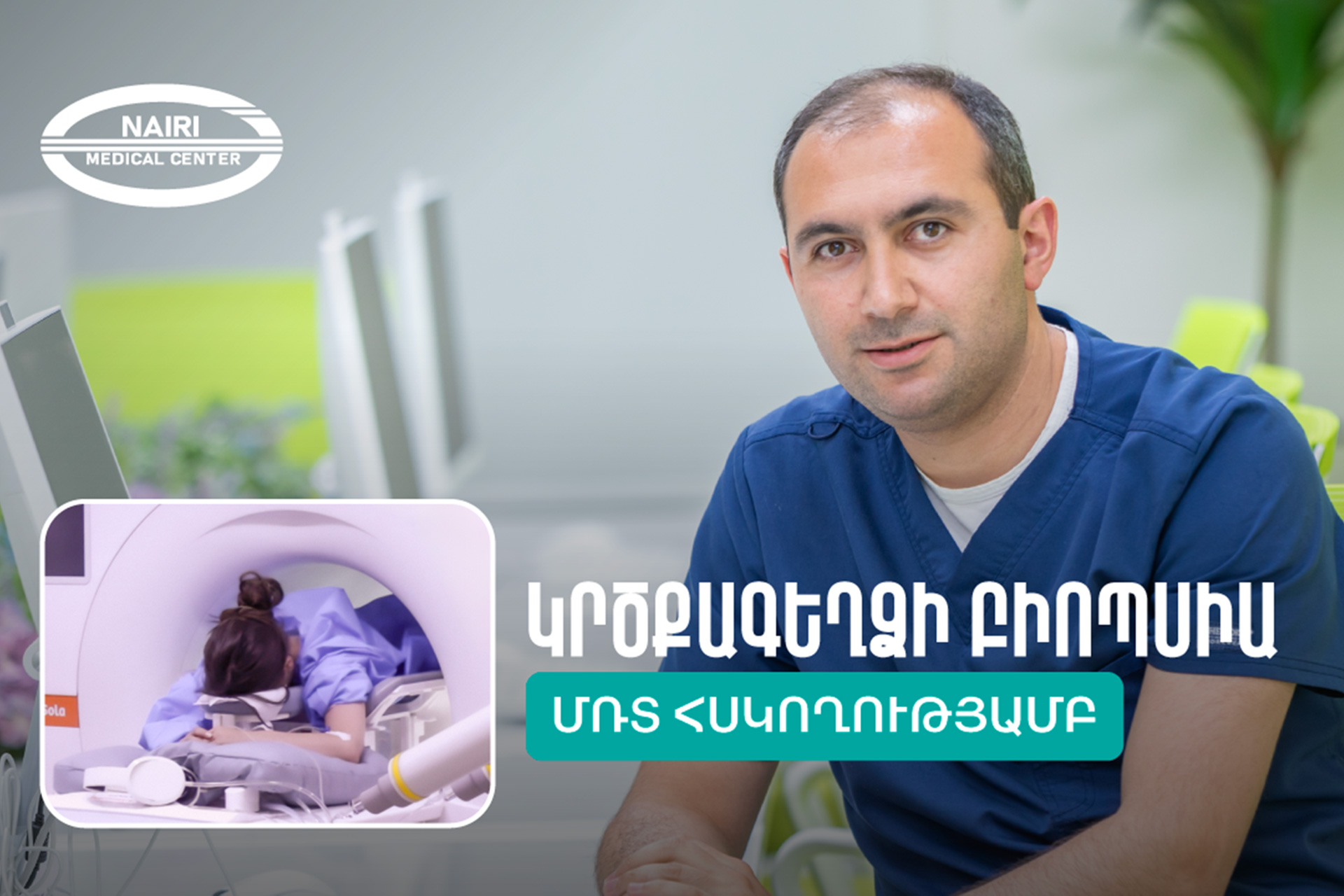
We spoke about the method with Artem Stepanyan, Head of the Oncologic Surgery Service.
“Almost every day, we read about a new treatment, a new diagnostic method, or a newly developed medicine. Medicine is changing very quickly, and it is encouraging that oncology is developing just as actively.
Cancer surgery, which plays a major role in cancer treatment, is also developing rapidly, and new approaches are gradually becoming part of international medical guidelines.
Traditionally, cancer surgery involves removing the organ affected by the tumor or removing the malignant tumor together with the surrounding tissues and nearby lymph nodes where cancer cells may potentially have spread.
However, in many cancers, metastases first reach only one to three lymph nodes. These are called sentinel lymph nodes.
With traditional surgery, these sentinel nodes can usually be identified only after a larger group of lymph nodes has already been removed and examined.
This type of surgery also has disadvantages. It can be extensive and traumatic and may lead to complications after surgery.
In some cancer operations, 40–60 and sometimes even up to 100 lymph nodes may be removed. If no metastases are later found in these nodes, this is of course good news for both the patient and the doctors.
However, the lymphatic system and lymph nodes play an important role in the normal function of the body. Removing a large number of lymph nodes may lead to problems such as lymphedema.
For example, after surgery for breast or uterine cancer, patients may develop swelling of the arms or legs and reduced movement of the affected limb.
So although this type of surgery can be lifesaving, it may also have a major impact on the patient’s quality of life.
The new method now used at Nairi Medical Center allows us to identify sentinel lymph nodes during the operation itself and remove only the nodes that may be affected.
This solves two important problems at the same time: potentially affected lymph nodes are removed, while healthy lymph nodes are preserved and can continue to perform their normal function.
In women with certain cancers, the procedure is performed laparoscopically.
Laparoscopic surgery also has several advantages. Instead of a large incision, the operation is performed through four small openings.
For example, in the past, a patient undergoing surgery for uterine cancer might have needed to stay in hospital for several days or even longer. With the laparoscopic approach, in suitable cases the patient may be able to leave the hospital as early as the next day.
The procedure works as follows. A special substance called indocyanine green, or ICG, is injected into the affected organ, for example into the area of the uterus.
Using fluorescence imaging during surgery, the sentinel lymph nodes become visible. Special equipment allows the surgeon to see the lymph nodes that may potentially be affected and remove them.
This method is used in the treatment of both uterine and breast cancers. Because unnecessary healthy lymph nodes are not removed, the risk of later complications can be reduced.
The method has very few contraindications because only a small amount of the substance is injected directly into the target area. One important limitation is a history of certain allergic reactions, including reactions related to the substances used during the procedure.
There are also limits on when the method can be used. It is mainly recommended for early-stage tumors. In more advanced cancer, affected lymph nodes may already be enlarged or visibly changed and can be identified without this technique.
Sentinel lymph node detection and removal has been used in oncology for more than 15 years.
At first, the method was considered experimental. Over time, it became part of accepted clinical practice and international guidelines in gynecologic oncology.
Today, it is widely used in the treatment of uterine, cervical, and breast cancers.
I have personally taken part in the development of European clinical guidelines and am one of their authors.
Today, this method is widely used as an effective modern approach.
For every doctor, the patient’s health is the priority, and any method that helps reduce the burden of treatment is very important.
The main value of this approach is that it helps preserve the patient’s quality of life.
In the past, the main goal was simply to save the patient’s life. Today, the goal is not only survival, but also helping patients continue to live a full life without avoidable long-term problems caused by treatment.”